Skip to content

Is your deck showing its age? Before spending money on new boards—or tearing everything down—it’s worth understanding the difference between a simple repair, deck resurfacing, and a complete rebuild. For Twin Cities homeowners, Minnesota’s freeze-thaw cycles, moisture, and the condition of the structure beneath the boards can make that decision especially important.
Quick answer: Repair isolated damage when the rest of the deck is sound. Consider resurfacing when the existing structure is safe, code-appropriate, and compatible with new decking. Consider replacement when critical framing, footings, or connections have deteriorated—or when a different layout requires major structural changes. A qualified professional should assess structural concerns before work begins.
When is a deck repair enough?
Limited issues don’t always justify a full deck replacement. Depending on the product and construction, a repair might address a small number of damaged or loose boards, a failed fastener, or a localized railing component. The key question isn’t just whether the visible problem can be fixed; it’s whether the structure around it remains sound.
For composite or PVC decking, follow the manufacturer’s instructions for replacing boards, compatible fasteners, and any applicable warranty conditions. Avoid painting, sanding, or using harsh cleaners without checking the product’s care guidance. A surface fix should never conceal a structural problem.
When does resurfacing make sense?
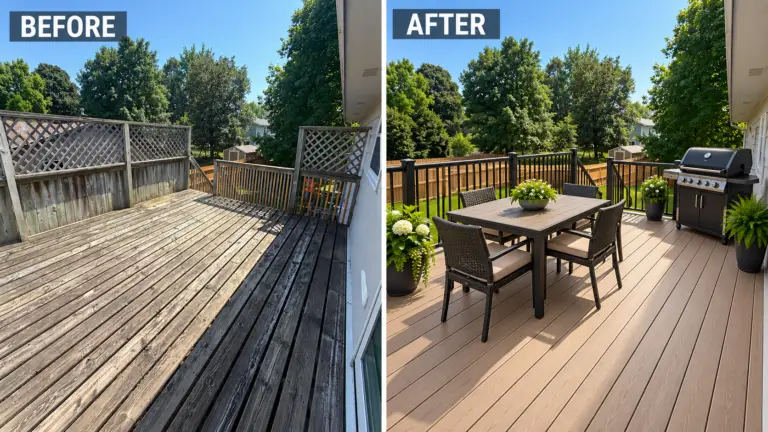
Resurfacing typically means removing worn deck boards and installing new decking—sometimes with new railing—while keeping suitable existing structural framing. It can be attractive when you like your current deck’s size and layout and the supporting structure is in good condition.
However, resurfacing isn’t just a cosmetic decision. Before reusing the framing, a professional should review the joists and beams, their spans and spacing, fasteners and connectors, ledger attachment and flashing, footings, signs of decay, and compatibility with the chosen decking system. New composite or PVC boards won’t correct an unsafe deck underneath.
For a closer look at that specific project, see our guide to replacing wood deck boards with composite decking.

Signs that a complete deck replacement may be smarter
- Persistent movement or instability: Noticeable sway, significant unevenness, or movement at connections calls for investigation.
- Rot or deterioration in structural members: Damage in joists, beams, posts, or the ledger can make a surface-only project impractical.
- Foundation concerns: Settling or heaving supports can affect the whole structure. Minnesota’s seasonal frost makes footing design especially important.
- Unsafe stairs or railing connections: Wobbly guards, damaged stair framing, or other safety concerns need more than new deck boards.
- A major redesign: Changing the deck’s size, height, stairs, or load-bearing features can require significant reconstruction.
- Repeated costly repairs: If multiple areas need work and more issues are likely, a rebuild may provide better long-term value.
Safety note: If you suspect a deck is structurally unsafe, stop using it until an appropriately qualified professional evaluates it. Don’t assume the deck is safe because the boards still look good.
Why Minnesota deck conditions matter
Water management, winter conditions, and shifting soil affect the longevity of exterior structures. A professional evaluation should account for drainage, frost-related footing performance, weather-exposed framing, and the way the deck attaches to the house. Local permit and inspection requirements depend on the municipality and scope of the work; check with the authority having jurisdiction before beginning a substantial repair or replacement.
Foundation options are worth discussing when rebuilding. UglyDeck explains its approach to concrete versus helical deck footings in a separate article.
Repair, resurface, or replace: how to compare the costs
A repair usually has the narrowest scope, but the final price depends on accessibility and the extent of hidden damage. Resurfacing adds new boards and potentially railing while retaining approved, usable components. Replacement typically includes demolition and rebuilding structural elements, but can make sense when extensive repairs are required or the design is changing.
Ask contractors for a written scope showing what stays, what is replaced, what happens if concealed damage is found, and who is responsible for permits and inspections. Compare the expected useful life and ongoing maintenance as well as the upfront number. A low resurfacing price isn’t a bargain if the supporting structure needs replacement soon afterward.
Should you switch from wood to composite or PVC decking?
When the time comes to replace deck boards or rebuild, many Twin Cities homeowners consider low-maintenance composite or PVC instead of wood. These products generally eliminate routine staining and sealing, but they still require periodic cleaning and proper installation. Product lines differ in appearance, temperature underfoot, traction, and warranty terms. Just as important, the framing must meet the selected manufacturer’s installation requirements.
Explore our comparison of composite, PVC, and wood decking for Minnesota weather to narrow the options before choosing a product.
What should a professional deck evaluation cover?
Before committing to a major project, ask how a deck builder determines whether the existing structure can be reused. Discuss the condition of the ledger and flashing, joist and beam integrity, support posts and footings, stairs and guardrails, and whether the proposed materials will work with the existing layout. Some conditions may not be visible until boards are removed, so ask in advance how discoveries and change orders will be handled.
For more questions to bring to a contractor meeting, see 10 questions to ask before hiring a Twin Cities deck builder.
Ready to explore a new deck in the Twin Cities?
If your existing deck is nearing the end of its life, UglyDeck can help you explore low-maintenance materials and professional deck installation options. Whether you are considering a similar replacement or a new layout, set up an appointment to discuss your goals and the next steps for your project.