Skip to content

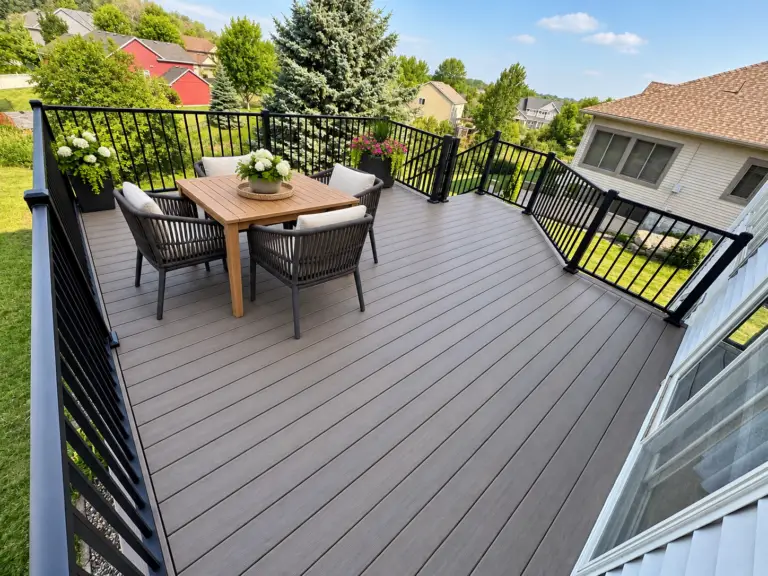
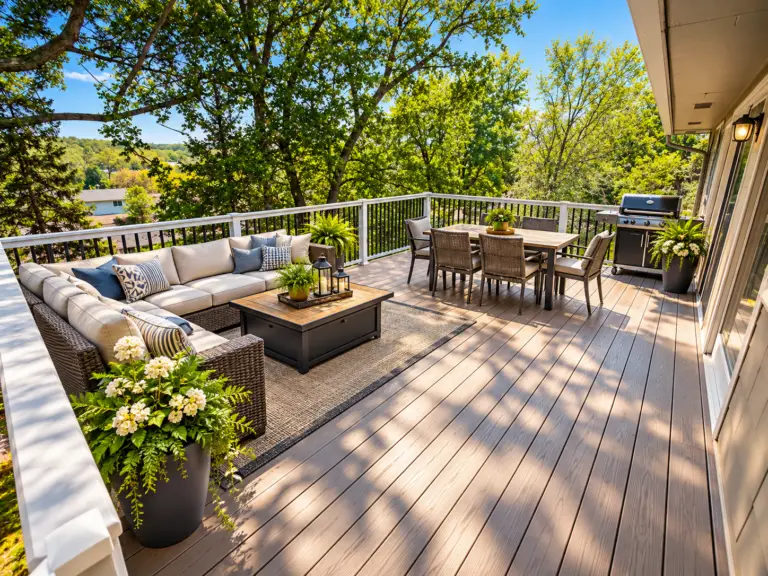
What’s the best decking material for your home? The right choice depends on your priorities: appearance, initial cost, long-term upkeep, and how you want to enjoy your outdoor space. Composite and PVC are leading low-maintenance options for Minnesota homeowners, while pressure-treated wood has a lower initial price but greater ongoing maintenance needs. Yet choosing a deck involves more than picking the surface: your decking is only as good as the frame you put it on.
At UglyDeck, we help Twin Cities homeowners choose quality decking and build a sound structure underneath. Here’s what to compare before making a decision.
Composite decking: Wood-inspired looks with less upkeep
Most composite decking combines wood fibers and polymers, often beneath a protective cap. It comes in many textures, colors, and prices. A key advantage over traditional wood is that composite boards generally do not require periodic staining, painting, or sealing. They still need occasional cleaning and appropriate care, and resistance to fading, scratching, and staining varies by product.
Best for: Homeowners seeking a balance of appearance, low maintenance, and budget flexibility.
PVC decking: Premium options without a wood-fiber core
PVC, sometimes described as advanced polymer decking, is made without the wood-fiber core found in most composite boards. It offers a wide range of finishes and can be appealing for outdoor spaces exposed to moisture. Depending on the collection, it may cost more than composite. Surface temperature, feel, color, expansion, and installation requirements vary, so no one PVC board is automatically the best choice for every household.
Best for: Homeowners who want to compare premium low-maintenance materials, colors, and performance features.
Pressure-treated wood: Lower initial cost, more maintenance
Pressure-treated wood is a familiar decking surface that generally costs less initially than composite or PVC. It offers the appearance of natural wood but typically needs more cleaning and periodic staining or sealing. Wood can also change appearance as it weathers. Compare that long-term effort and expense—not only the first quote—when choosing a surface material.
UglyDeck specializes in low-maintenance composite and PVC deck surfaces for professionally installed decks. We still rely on quality pressure-treated wood where it makes sense structurally, particularly in the framing below the finished boards.
What about hardwood and other specialty decking?
Tropical hardwoods and specialty materials can offer distinctive appearances, but availability, cost, installation practices, and upkeep vary considerably. Our focus at UglyDeck is helping homeowners choose among quality composite and PVC collections rather than presenting every possible material as one we install.
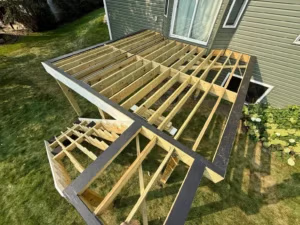
Your decking is only as good as the frame underneath it
A beautiful finished deck needs a strong, straight, carefully constructed frame. Joists, beams, and posts determine how the deck is supported and how it performs over time. Framing quality is one reason two decks that look similar in photos can be built very differently.
Why UglyDeck uses #1-grade pressure-treated framing lumber
UglyDeck uses #1-grade pressure-treated lumber for our framing. Compared with widely available #2-grade lumber, #1 grade has tighter limits on certain characteristics, including knots and other features that affect grading. Depending on the species and dimensions, it can also have higher assigned structural design values. We select and install our framing members carefully to create a straight, consistent platform for the finished decking.
Higher-grade lumber gives us a quality starting point, but it isn’t a promise that wood will never twist or move. Lumber is a natural material, and good storage, handling, drying, design, and construction practices also matter.
Can #1-grade lumber allow fewer posts and beams?
Sometimes, yes—and that can make a real difference in how the finished deck looks. Stronger framing members can offer greater span capacity in certain designs, potentially allowing a more open layout with fewer visible support posts or a different beam arrangement. That can create cleaner sightlines and more usable space beneath an elevated deck.
Fewer supports are never automatic just because the lumber is #1 grade. The final plan must satisfy the applicable span and load calculations, including the actual lumber species and grade, joist and beam sizes, local requirements, and footing capacity. Our goal is a clean-looking deck that’s properly supported—not to eliminate supports at the expense of strength.
How kiln-dried framing helps reduce movement
Pressure-treated lumber can contain considerable moisture when installed. As it dries, it may shrink, twist, or change dimension. Depending on location and availability, UglyDeck uses kiln-dried-after-treatment (KDAT) lumber to reduce moisture before installation. This helps minimize some of the shrinkage and movement after construction, though no wood framing is completely movement-free.
For homeowners, that extra attention helps support the appearance and performance of the premium decking installed above it.
Why not always use aluminum or steel framing?
Aluminum and steel framing systems have advantages, including dimensional consistency and different durability characteristics. They can also add substantial cost, depending on the system, the structure, and the design. UglyDeck believes carefully selected #1-grade pressure-treated framing offers an excellent balance of structural performance, longevity, appearance, and value for many residential decks.
Installation details matter as much as material selection
Even the best framing lumber and finished decking depend on sound construction. Joist spacing, beam sizing, blocking, foundations, ledger attachment and flashing when applicable, drainage, fasteners, stairs, and railings all matter.
Composite and PVC boards also expand and contract with temperature changes. UglyDeck follows the relevant product requirements for spacing, gapping, and fastening to accommodate that normal movement throughout Minnesota’s seasons.
Learn more about our professional deck installation approach.
How to choose the best decking material for your project
- Appearance: Compare samples in real daylight, not just online photos.
- Budget: Compare complete installed quotes, including the frame, foundation, stairs, and railing.
- Maintenance: Ask what cleaning, staining, or sealing the specific surface requires.
- Warranty: Many premium composite and PVC collections have limited warranties of 25 years or longer; fade, stain, and damage provisions vary.
- Framing: Ask what lumber grade, moisture condition, spacing, beams, and posts are included in the proposal.
- Installation: Consider drainage, structural connections, foundations, flashing, and manufacturer-approved fastening.
For more detail, read our guides to decking materials for Minnesota weather and what low-maintenance decking really means.
Build a deck that’s beautiful above and strong below
UglyDeck helps Twin Cities homeowners compare composite and PVC decking, select aluminum railings, and build professionally installed decks with careful attention to the frame beneath the surface. Set up an appointment to explore the options for your home.