Skip to content

How long does composite decking last? For many modern residential composite decking products, 25 to 30 years is a reasonable starting point for planning, and some premium collections carry manufacturer limited warranties of 35 or 50 years. But warranty length is not a promise that every board—or the entire deck—will look new or last exactly that long. The decking material, local conditions, maintenance, and especially the structure and installation beneath it all influence the life of the finished deck.
For Minnesota homeowners facing hot summers, freezing winters, snow, and moisture, understanding the difference between a long-lasting decking surface and a long-lasting deck matters.
How many years can composite decking last?
Composite decking isn’t one uniform product. Different brands and collections use different cores, caps, fastening systems, and performance specifications. High-quality products are engineered to resist common problems associated with untreated wood, including splintering and certain forms of moisture-related deterioration. Most don’t require routine staining or sealing.
Across the major low-maintenance decking brands UglyDeck offers—Deckorators, TimberTech/AZEK, and Trex—25-year limited warranties are a common starting point for many collections. Some premium products provide longer coverage. For example, certain TimberTech/AZEK lines offer 50-year limited fade-and-stain protection, with separate product warranty terms. The coverage depends on the exact collection, and a warranty period is not a measured average of how long every installed deck will last.
The practical takeaway: choose the exact collection and examine its written warranty and care instructions rather than relying on a generic claim that all composite decking lasts a certain number of years.
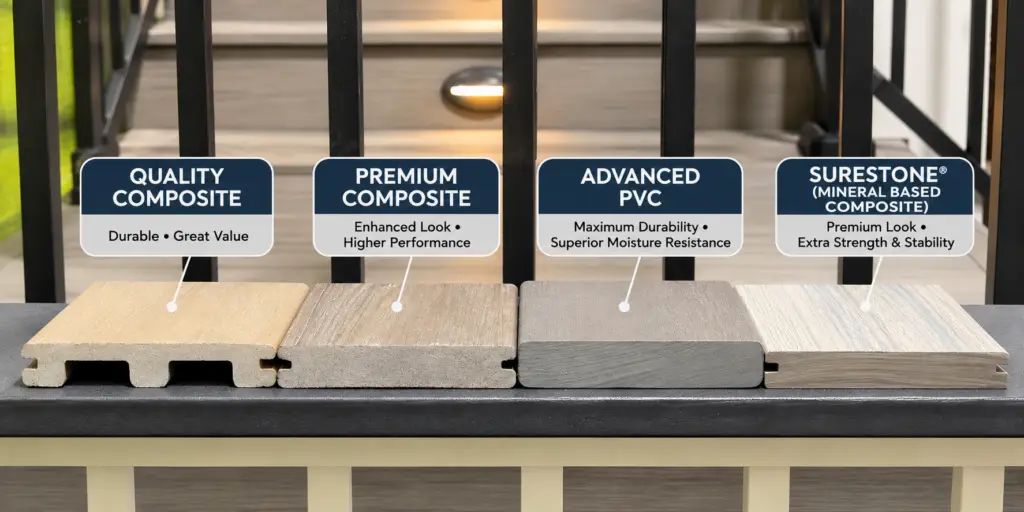
Composite vs. PVC vs. wood: What affects lifespan?
Composite decking
Most traditional composite boards combine polymers with wood fibers and a protective surface. They are designed to reduce the need for refinishing compared with wood. Durability varies by collection, the condition of the structure underneath, and how the boards are used and maintained.
PVC decking
PVC, sometimes described as advanced polymer decking, contains no wood-fiber core. Certain premium PVC products come with especially long limited manufacturer warranties; for example, some TimberTech Advanced PVC collections carry limited lifetime product coverage and separate 50-year fade-and-stain coverage. Those terms are specific to the product, and the supporting frame has its own service-life considerations.
Traditional wood decking
Pressure-treated wood can serve homeowners for many years, but its surface typically needs more upkeep, including periodic cleaning and refinishing. Actual longevity depends on wood species, exposure, drainage, construction quality, and maintenance. Wood decking does not have one universal lifespan.
For a fuller product comparison, see What Are the Best Materials for Building a Deck?
What do composite decking warranties actually protect?
Many manufacturers offer limited warranties covering specified material defects and, for eligible collections, certain amounts of fading or staining. It’s important to separate fade-and-stain warranty protection from accidental or homeowner-caused damage.
- Fading: A manufacturer may warrant against color change beyond a defined threshold. This doesn’t mean absolutely no visible color change will occur.
- Staining: Coverage may apply only to certain substances and only when the owner follows cleaning deadlines and care instructions.
- Scratches, gouges, impacts, and misuse: These may be excluded. The exact terms depend on the product.
- Installation and framing: Improper installation or movement of a supporting structure may fall outside a decking manufacturer’s coverage.
For many popular composite and PVC collections, a 25-year limited warranty is a useful baseline; some premium lines, including certain TimberTech/AZEK products, offer 50-year protection for specified claims. A longer term isn’t automatically better if exclusions, prorating, labor coverage, or transfer rules differ. Compare the written terms for the exact products you’re considering rather than choosing by warranty length alone.
What about UglyDeck’s 10-year workmanship guarantee?
A long-lasting deck depends on more than the materials you choose. The quality of the installation matters just as much.
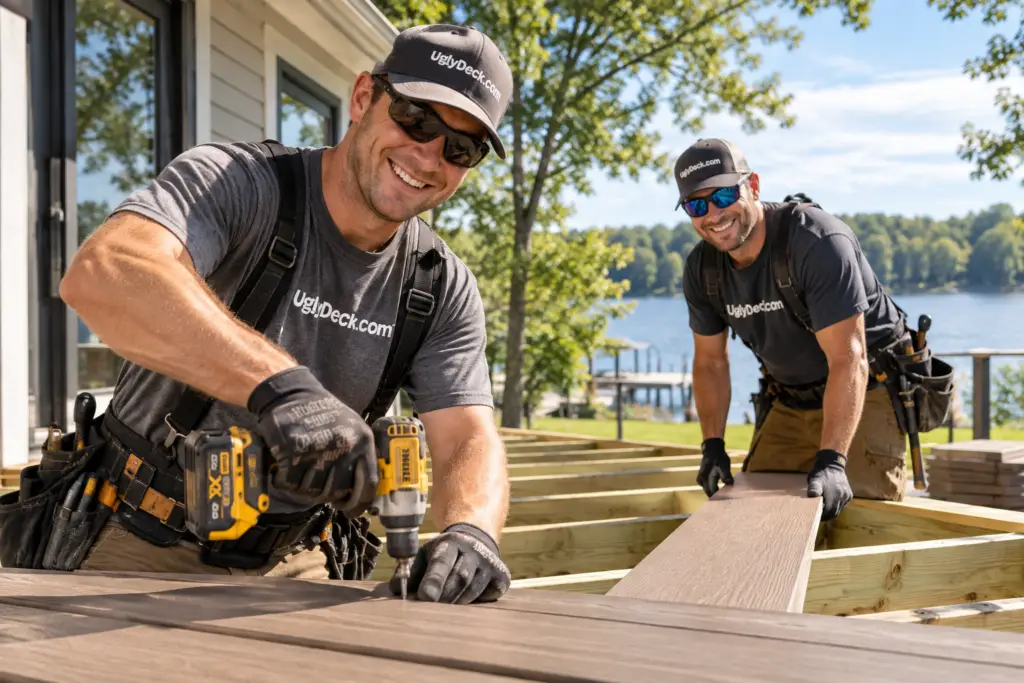
That’s why UglyDeck has stood behind its professional installation work with a 10-year workmanship guarantee since the company began. While decking manufacturers provide warranties on their products, UglyDeck’s workmanship guarantee provides an additional layer of protection for qualifying issues related to our installation work, subject to the terms of the guarantee.
From the framing and structural connections to the finished decking and railing, we believe homeowners deserve confidence in the craftsmanship behind their investment. It’s one more reason to look beyond the decking brand when comparing contractors: a quality product deserves a quality installation and a company willing to stand behind its work.
Why the framing underneath can determine how long a deck lasts
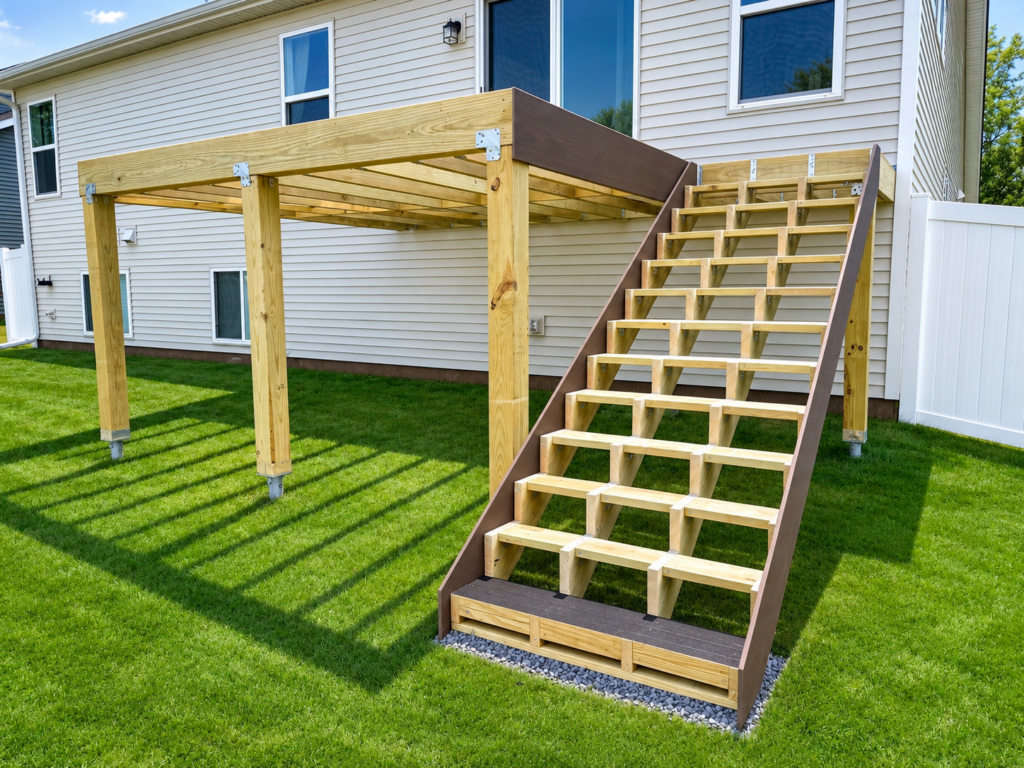
Your decking is only as good as the frame you put it on. A long-lasting composite or PVC board still depends on properly built joists, beams, posts, connections, and foundations. Problems below the surface can affect even premium decking.
At UglyDeck, we use #1-grade pressure-treated framing lumber rather than choosing framing solely on its initial price. Compared with commonly available #2-grade lumber, #1-grade lumber has tighter grading limits on certain defects. Depending on the wood species and structural design values, that choice can offer greater span flexibility and potentially cleaner layouts with fewer visible supports, subject to the actual engineering, loads, and local code.
Where available and appropriate for the project, we use kiln-dried-after-treatment (KDAT) lumber to reduce excess moisture before installation. This helps limit some of the shrinkage and twisting that can occur as wetter pressure-treated lumber dries. Wood remains a natural material and can still move with changing conditions.
We also pay close attention to drainage, ventilation, blocking, fastening, footing support, and ledger flashing where applicable. These aren’t glamorous details, but they help protect the deck’s long-term performance.
Does Minnesota weather shorten composite decking life?
Minnesota’s temperature swings put outdoor materials through repeated seasonal changes. Modern composite and PVC decking is manufactured for outdoor exposure, but boards can expand and contract with temperature changes. Some movement is normal—not necessarily a product defect.
UglyDeck follows the specific manufacturer’s requirements for board spacing, end gaps, joist spacing, and fastening to accommodate that movement. Boards that buckle, lift, or create a safety concern should be inspected rather than dismissed as normal expansion.
Snow and ice care matters too. Follow the manufacturer’s directions about shovels, deicers, and cleaning products. Avoid assuming that metal scraping tools or every type of ice melt is safe for every decking surface.
How can homeowners help their composite deck last?
Low-maintenance doesn’t mean zero-maintenance. A few simple habits help protect the finished surface and make it easier to spot issues early:
- Remove leaves, dirt, and debris so moisture doesn’t accumulate unnecessarily.
- Clean spills promptly using products approved for your specific collection.
- Keep gaps and drainage paths clear.
- Use only manufacturer-approved snow removal and cleaning methods; pressure-washing instructions vary.
- Periodically check stairs, railing connections, fasteners, and accessible framing for signs of trouble.
- Have a professional assess significant movement, soft framing, loose connections, or changes in the deck’s support.
For more care guidance, see What Does Low-Maintenance Decking Really Mean?
When should you repair, resurface, or replace an aging deck?
A faded or damaged deck board doesn’t automatically mean the entire deck needs to be replaced. Conversely, decking that still looks good is no guarantee that the underlying frame is sound. Resurfacing can sometimes make sense when the existing structure is properly evaluated and suitable for the new boards; structural deterioration may make full replacement the wiser investment.
Our guide, Should You Repair, Resurface, or Replace Your Deck in Minnesota?, explains how to think through that decision.
Build for longevity, not just appearance
Composite decking can be a long-term investment, especially when paired with a well-built frame and careful installation. At UglyDeck, we help Twin Cities homeowners compare composite and PVC products, select aluminum railing, and build professionally installed decks with attention to the structure beneath the surface.
Set up an appointment to discuss a low-maintenance deck designed for your home and Minnesota’s seasons.